The Complete Guide to Choosing the Right CCTV & Surveillance System for Your Business
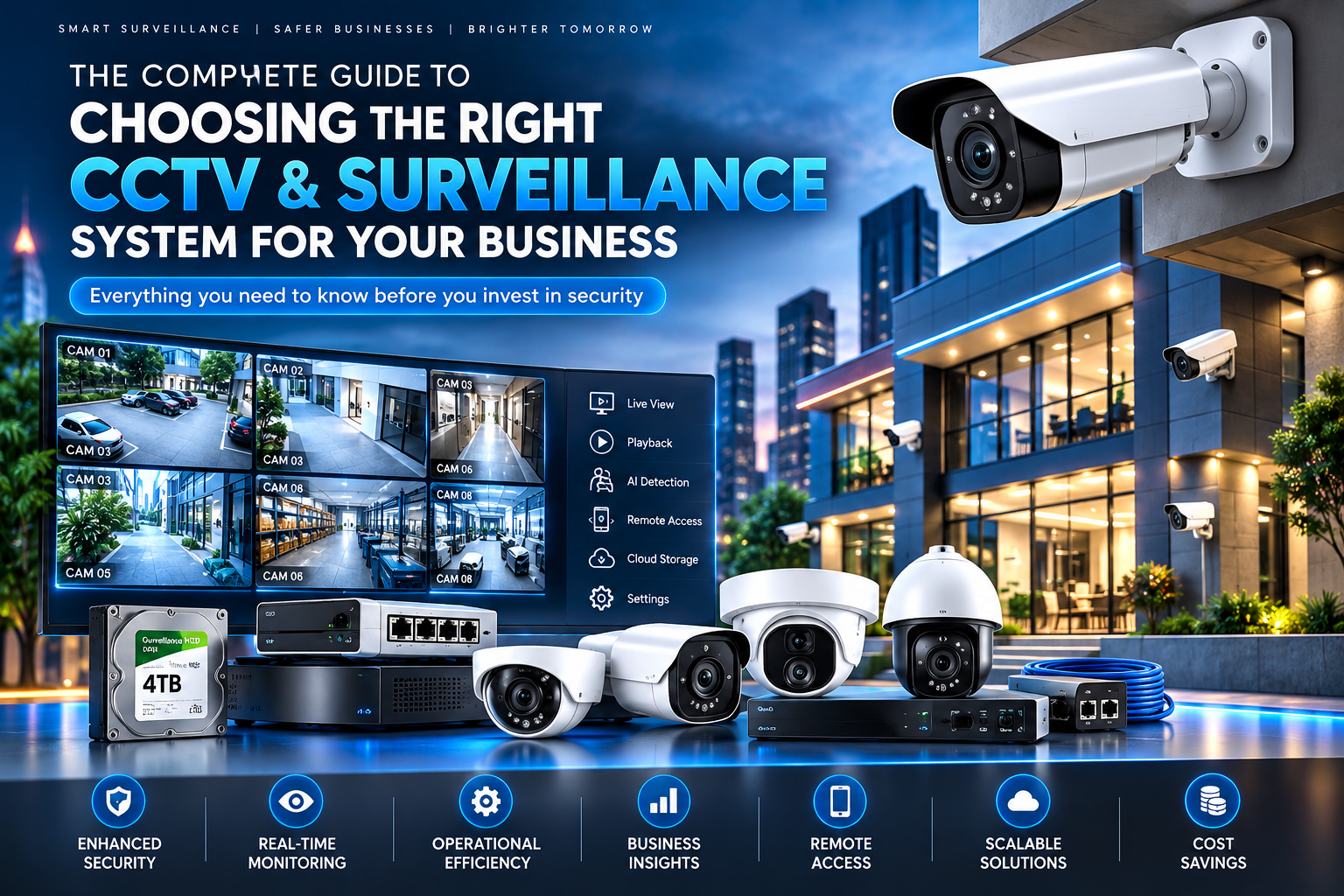
# The Complete Guide to Choosing the Right CCTV & Surveillance System for Your Business
A reliable CCTV system is more than just a collection of cameras. The right surveillance solution combines cameras, recording hardware, storage, networking, monitoring, and smart security features to provide dependable protection for your business.
Whether you operate a retail store, office, warehouse, factory, commercial building, or other business facility, selecting the right system starts with understanding your actual security requirements.
1. Identify Your Surveillance Requirements
Before selecting products, determine what areas need protection and what you need the cameras to capture.
Consider:
Also consider lighting conditions, viewing distance, camera mounting height, and whether you need indoor or outdoor protection.
2. Choose the Right CCTV Camera Type
Different camera designs are suitable for different applications.
Dome Cameras
Dome cameras are commonly used indoors and in commercial environments. Their compact design makes them suitable for offices, shops, corridors, and reception areas.
Bullet Cameras
Bullet cameras are useful when you need a more directional field of view. They are commonly installed around building exteriors, entrances, parking areas, and perimeters.
PTZ Cameras
Pan-Tilt-Zoom cameras provide remote movement and optical zoom capabilities. They can be useful for monitoring larger areas where operators need to change viewing direction or zoom into specific locations.
Specialised Cameras
Depending on the application, businesses may also require cameras with features such as low-light imaging, long-range monitoring, audio, thermal imaging, or advanced analytics.
3. Consider Image Resolution
Higher resolution can provide greater image detail, but resolution should be selected according to the application.
Common options include:
For general monitoring, lower resolutions may be sufficient. For areas where identification and detailed image capture are important, higher-resolution cameras can provide additional detail.
4. Look at Night Vision Performance
A surveillance system should provide useful images during both daytime and nighttime conditions.
When evaluating cameras, consider:
The right combination depends on the environment and available lighting.
5. Select the Right NVR or DVR
The recorder is the central component that manages video recording.
For IP camera systems, an NVR is commonly used. For compatible analog or HD-over-coax systems, a DVR may be appropriate.
When selecting a recorder, consider:
Choose a recorder that provides enough capacity for your current requirements while allowing room for future expansion.
6. Plan Your Storage Capacity
Video storage requirements depend on several factors, including:
Surveillance-grade hard drives are designed for continuous recording environments. Select storage according to the required retention period and system workload.
7. Don't Ignore Networking
For IP surveillance systems, network infrastructure is extremely important.
A reliable network may include:
PoE networking can simplify installation by allowing compatible cameras to receive power and data through a single network cable.
8. Consider AI-Based Surveillance Features
Modern surveillance systems can provide more than basic motion detection.
Depending on the camera and recorder, intelligent features may include:
AI features can help reduce unnecessary alerts and make video investigation more efficient.
9. Remote Monitoring
Remote access allows authorised users to view cameras and receive alerts from connected devices.
Before selecting a system, check whether it supports:
Remote monitoring can be particularly useful for business owners and managers who need visibility when they are away from the premises.
10. Think About Future Expansion
A surveillance system should not only meet today's requirements.
If you expect your business to expand, consider choosing:
Planning for expansion can reduce the need for major infrastructure changes later.
11. Choose Genuine Products and Reliable Support
Product quality and after-sales support are important parts of a surveillance investment.
Work with a reliable distribution and support partner that can help with:
A dependable support network can make the overall surveillance deployment smoother.
12. Build a Complete Surveillance Solution
A professional CCTV system is made up of several interconnected components:
**Cameras → Network → NVR/DVR → Storage → Monitoring → Remote Access**
Every component should be selected to work correctly with the others.
Instead of choosing individual products only on price, consider the complete system requirements, compatibility, reliability, future expansion, and ongoing support.
Conclusion
Choosing the right CCTV system requires more than selecting a camera with the highest resolution. Your decision should consider the environment, coverage requirements, camera type, recording capacity, storage, networking, AI features, remote monitoring, scalability, and after-sales support.
A well-planned surveillance system can provide better visibility, easier monitoring, and a stronger foundation for protecting your business.
**Red Chip Technology** provides surveillance and networking solutions for CCTV dealers, installers, and businesses, including cameras, NVR/DVR systems, networking equipment, storage, accessories, technical support, warranty assistance, and RMA coordination.
**Need help selecting the right surveillance solution for your project? Contact Red Chip Technology.**
Deploying a Surveillance or Optical Project? Partner with Red Chip.
We supply systems integrators, government contractors, and enterprise dealers with direct tier-1 manufacturer warranties, rapid multi-branch dispatch, and pre-sales optical engineering assistance.


